
A friend invited you to a grief circle, or your job just put a “healing circle” on the team calendar. Now you’re wondering if you’ll have to cry in front of strangers or spill your deepest secret. So what is a healing circle, really? It’s a small group of people who sit together, take turns speaking and listen without trying to fix anyone.
I’m Ashley Ali, a Queens-based spiritual counselor who holds circles around New York and on Zoom for people all over the U.S. My School Counseling background made me a stickler for structure and safety. Below, you’ll learn how circles run, what a first one feels like and how to host your own.

What Is a Healing Circle? A Plain Definition
UC Davis Health describes healing circles as a safe, inclusive space to explore differences, unburden our struggles and build community. Everyone in the circle is equal, and everyone has an equal chance to speak. Nobody sits at the head of the table, because there is no head of the table.
Another model comes from Commonweal, whose Healing Circles project was conceived in 2014. Commonweal describes its circles as free and open to all, with circles for people touched by cancer, chronic illness or grief. Its guidelines say members don’t advise, fix or save one another, and they keep every story confidential.
So a healing circle is not group therapy, a lecture or a debate. Instead, it’s a practice of shared presence. You speak when you’re ready, you listen when others speak, and the group holds whatever comes up.
Where Circles Come From
Circles are old, and they don’t belong to one culture. UC Davis Health traces the circle process to the traditional discussion and healing practices of Indigenous peoples around the world. I honor that lineage instead of claiming it, so I keep my circles simple and never borrow another nation’s sacred ceremony.
You’ll recognize the shape in many places, too. Think of aunties shelling peas on a porch, elders around a kitchen table or neighbors in a church basement after a funeral. In many Hindu homes and mandirs (temples), people gather for satsang, which literally means “the company of truth,” to sing bhajans (devotional songs), chant and listen to a spiritual talk. Satsang looks different from one mandir and family to the next, so an elder or pandit can tell you how yours gathers.
How a Healing Circle Works, Step by Step
Every keeper, the person who guides the circle, runs things a little differently. Even so, most good circles share the same bones. This is the shape I follow, whether we meet in a community room in Queens or on a Zoom screen.
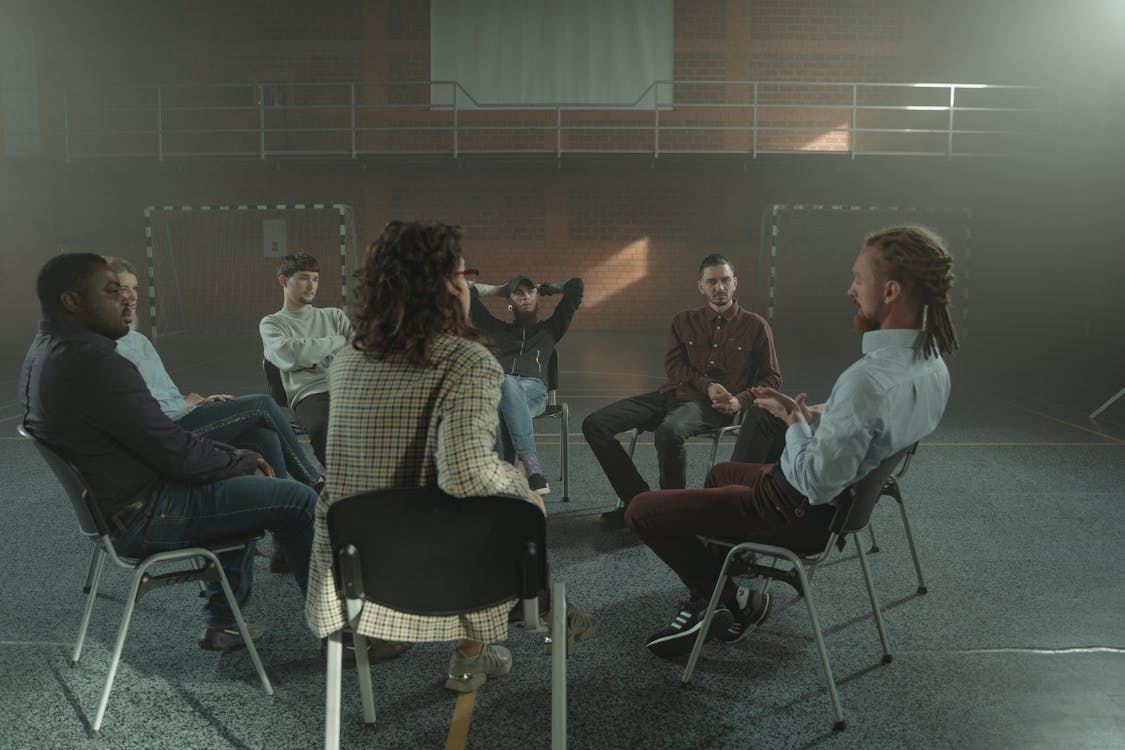
Opening and agreements
First, we arrive. I invite everyone to sip some water, take three slow breaths and feel their feet on the floor. Then we read our agreements out loud, so nobody has to guess the rules.
- Speak from your own experience, using “I” instead of “you should.”
- Keep what others share inside the circle, because their story is theirs to tell.
- Hold back advice, fixing and saving, even with the best intentions.
- Pass whenever you want, with no explanation needed.
- Care for your body by stretching, stepping out or grabbing a tissue anytime.
The talking piece
Next comes the talking piece. It can be a smooth stone, a shell or anything else that fits in a palm. Whoever holds it speaks, everyone else listens, and then it moves to the next person. On Zoom there’s nothing to pass, so a speaking order posted in the chat can do the same job. Each person says “I’m done” or “I pass” to hand off the turn.
This one small object changes the whole room. Because only one person speaks at a time, quieter people finally get space. Meanwhile, louder folks get to practice listening. Both are gifts.
Listening without fixing
This is the hardest part for most of us. When someone we care about hurts, we want to rush in with a solution. However, in a circle, the most loving thing you can do is listen all the way to the end. A person who just shared that their father died doesn’t need a lecture.
Try leaving these phrases at the door:
- “At least you still have your kids.”
- “Have you tried yoga?”
- “Everything happens for a reason.”
- “Just think positive.”
That last one is spiritual bypassing, which means using spiritual talk to skip over real pain. Instead, try a simple “thank you for sharing,” or just a nod and some quiet. If a story stirs something in you, save it for your turn and speak about yourself. For example: “When you talked about your dad’s garden, I thought of my grandmother’s.”
Closing the circle
Finally, we close on purpose, so no one walks out raw. I ask each person for one word that sums up how they’re leaving. Then we breathe together, and I remind everyone to drink water and eat something real.
Types of Healing Circles I Hold
Every circle I lead has a theme, because a clear purpose helps people feel safe. These are the four I hold:
- Grief circles. These are for anyone missing a parent, partner, friend or even a pet. My mother passed in 2020, so this one sits close to my heart. You don’t have to be “over it” to come, and nobody will rush you.
- Ancestral circles. Together, we remember the people who came before us and name the gifts and burdens they handed down. If you’d like to start on your own first, I’ll cover how to begin ancestral healing at home in a separate guide.
- Seasonal and moon circles. We gather at new moons, full moons and seasonal turning points to reflect and set intentions. Between gatherings, you can try my full moon release ritual with no fire needed in your own apartment.
- Community care circles. These follow hard moments, like a death in a school community, layoffs at a nonprofit or a frightening event in the neighborhood. People need somewhere to set the heaviness down before they keep organizing.
That last type connects to a bigger idea called healing justice. Cara Page, who helped create the framework, argues that healing should shape how we do liberation work. In my words, healing is active. We don’t sit in a circle to escape the world; we sit so we can go back into it whole.
What to Expect at Your First Healing Circle
Nerves are normal. Many first-timers worry they’ll say the wrong thing or cry too much. Honestly, you can’t do a circle wrong, as long as you respect the agreements. And if you cry, the circle simply waits with you.

In person, you’ll walk into a room with chairs or cushions set in a ring. Often there’s a simple centerpiece, like flowers, a bowl of water or an LED candle. Wear comfy layers and bring a water bottle, because community rooms in New York are either freezing or tropical.
On Zoom, find a private corner and use headphones if you share your space. Keeping your camera on helps the group feel connected. That said, you can turn it off for a minute if you need to cry, stretch or chase a toddler.
Either way, you can pass every round and still belong, since listening is a full way to take part. Afterward, give yourself ten quiet minutes with a journal and these questions:
- What did I feel in my body when it was my turn?
- Which story stayed with me, and why?
- Where did I want to speak but hold back?
- How can I care for myself tonight?
When a circle isn’t enough
A healing circle is spiritual and community care, not therapy or medical treatment. If you live with depression, trauma or grief that won’t loosen its grip, a licensed therapist or doctor may be the right first call. Circles can sit alongside that care. If you’re in crisis or need to talk to someone now, call or text 988 to reach the 988 Suicide & Crisis Lifeline. Counselors answer calls, texts and online chats at no cost.
How to Host a Healing Circle for Your Community
Say you run a tenant association in Corona, a parent group in Bushwick or a staff network at a library in Harlem. Together, we’d plan your circle in five steps.
- Name the purpose. “Grief after a loss” or “rest after a long campaign” works better than a vague “healing.” A clear theme tells people what they’re saying yes to.
- Choose a trained keeper. UC Davis Health notes that circles go best with gentle facilitation from trained keepers. Ask any keeper you consider what they do when someone gets overwhelmed mid-share. A boss can join, but it helps when they sit as an equal instead of running the room.
- Do the math on time. If ten people each speak for about three minutes, one round already runs half an hour. For example, a 90-minute circle for that group might hold 15 minutes to open, two rounds and 15 minutes to close. A larger group works better split into several smaller circles.
- Make it truly optional. Nobody heals on command. At work especially, people need to know that skipping won’t count against them.
- Plan the care after. Share the 988 Lifeline, a short list of local therapists and any employee assistance program details. Then schedule a gentle follow-up, so the care doesn’t end when the circle does.
At work, a circle can also sit alongside a team wellbeing check-in, and my guide to what a team burnout workshop includes walks through that format. I hold circles in person from the five boroughs out to Long Island and upstate, plus New Jersey and Connecticut. Events farther away are welcome too, and I quote each engagement separately.
Common Healing Circle Questions
Is what I share in a healing circle private?
Everyone agrees to keep stories inside the circle. Still, that’s a promise between people, not a sealed vault. So share at a depth that feels safe today, and save the rest for a therapist or a trusted friend.
Is a healing circle the same as group therapy?
No. Group therapy is clinical treatment led by a licensed mental health professional. A circle offers peer support, reflection and spiritual care instead. I compare the two in my guide to spiritual counseling versus therapy.
How many people sit in one circle?
Smaller is usually better, because every person needs time to speak. As the math above shows, ten people sharing for three minutes each already fill half an hour. So larger groups work best split into several circles.
Come Sit With Us
A circle won’t fix your life, and it isn’t meant to. What it offers is simpler. A seat. A turn. People who listen all the way to the end. Sometimes that’s exactly what the heart needs before its next step.
If you’re curious, explore the grief, ancestral and moon circles I offer, in person or on Zoom. Want one for your team, mandir or block association? Send the details through my contact page: your purpose, rough group size, location and whether you’d like to meet in person or on Zoom. Come as you are. The circle makes room.